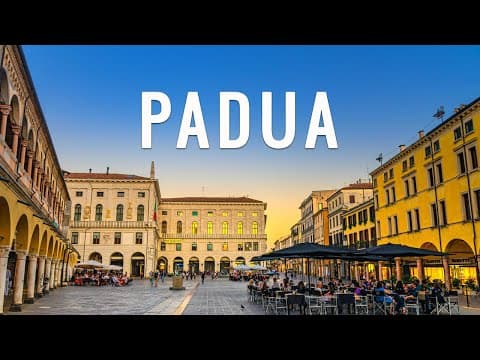

Padua (Padova), a prosperous university city in the Veneto region 30 kilometres west of Venice, is one of Italy's most art-historically important and underappreciated cities — home to one of the greatest works of art in the Western world, the Scrovegni Chapel, and to the tomb of Saint Anthony (the most visited pilgrimage site in Italy after the Vatican). The Scrovegni Chapel, commissioned in 1303 and decorated entirely by Giotto in the world's first great cycle of narrative fresco painting, is the dawn of Western art — the moment when flat Byzantine gold gave way to illusionistic three-dimensional space and human emotion. Reservations are essential and groups are limited to 25 for 20-minute visits. The chapel is alone worth the journey from anywhere in Italy. The Basilica of Sant'Antonio, with its Byzantine domes and Donatello bronzes, draws millions of Catholic pilgrims annually. The Piazza dei Signori and the extraordinary Palazzo della Ragione — a 13th-century law court with the largest unsupported medieval roof in Europe, containing a wooden Ptolemaic horse and the world's oldest astronomical clock — are highlights. The Botanical Garden (Orto Botanico), founded in 1545, is the oldest university botanical garden in the world (UNESCO). Padua is an excellent and significantly cheaper alternative base to Venice for exploring the Veneto. The city's cafés, particularly the ancient Caffè Pedrocchi, are splendid.
Plan your trip to Padua
Destination pre-filled — set your origin, dates and budget